Since the 1950s, American schools have been engaging in safety preparedness,
beginning with fire drills, evolving into additional emergency protocols, and
finally with active shooter training. Unfortunately, no evidence exists that these
measures bring any improvements in the sense of safety. As Dr. Daniel Siegel (2015) explains, students need to be “seen, safe, and soothed, in order to feel secure” (p. 145),
and these needs will not be met by current school safety practices alone. As
collective wisdom considers the emotional and social impact of these safety
measures, it is important to note that for more than a decade, US students have
been reporting how many of them miss school because of safety concerns. Karyn
Purvis and her colleagues remind us, there is a difference between being safe
and feeling safe: “Felt safety, which has to be determined by each
individual, includes emotional, physical, and relational security” (From The Connected
Child). It may be time to reconsider what is meant by
school safety and to determine what our children and young people really need
in order to feel the sense of safety required to thrive in school and beyond.
School Safety: A Perennial Issue for Some
Since 1999, the Center for Disease Control's Division of
Adolescence and School Health (CDC/DASH) has surveyed over four million US high
school students on health behaviors that contribute to physical, social, and
emotional problems. One of the questions addresses students’ sense of safety: “During
the past 30 days, on how many days did you not go to school because you felt
you would be unsafe at school or on your way to or from school?” From
2007-2017,
5-7% of US high school students have reported not going to school because of
safety concerns. These troubling results have remained stable with no
statistical difference across a decade.
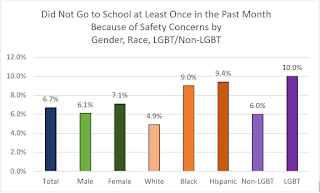
Looking deeper into the 2017 results, females have significantly
more safety concerns than males, and Black and Latino students have more safety
concerns than white students. Additionally, LGBTQ+ students have significantly
higher safety concerns than non-LGBTQ+ students. In a classroom of 30, two students stay home
at least one day a month because they are afraid before, during, or after
school.
The Neurobiology of Feeling Safe
Maslow’s Hierarchy of Needs is often
held up as a framework for acknowledging both physiological and psychological
needs in schools, especially with regard to safety. The premise is that basic human
needs must be fulfilled before social, esteem, and self-actualization needs are
considered. At the base of human needs are physiological needs, such as food and
shelter. The next level of needs is focused on safety and security. This need
for safety can be met with limits, consistencies, routines, and predictability.
From there, efforts can be made to fulfill the needs for self-esteem and
self-actualization. Using this model, schools might easily simplify the safety needs
of their students and mobilize all adults in the schools to play pivotal roles
in meeting these needs.
However, as Patricia
Rutledge
and others note, this understanding is too simplistic, because it fails to take
into account the prerequisite for social connections at every level of the
hierarchy. While it may not be included in current discussions, Maslow’s
original model sets preconditions that do indeed recognize the social
environment. The freedoms to speak and to defend one’s self are noted as
preconditions, as are honesty, justice, and order in groups. Maslow (1943) asserts,
“These conditions are defended because without them the basic satisfactions are
quite impossible, or at least, very severely endangered” (p.384). According to Maslow, then, a healthy social
environment is an imperative for meeting individual needs, including safety
needs.
Considering the impact of the environment on individuals, Steven Porges
(2017) explains
feeling safe as a neurobiology in his Polyvagal Theory. The neurobiological responses to relationships
and to the environment determine whether humans feel safe, and these
instinctual responses take precedence over a cognitive determination of safety.
Porges challenges the traditional structural ideas of safety that focus on
physical measures as they may have no impact on the feeling of safety. In other
words, the environment determines whether or not people feel safe, and feeling
safe may not be based on logic or fact. Porges advocates a shift in thinking
about safety that is a simple thought: it matters how people treat one another.
The Polyvagal Theory also asserts that feeling safe is the natural
state of the brain. In this state, humans are connected and fully present. Because
the brain perceives no risk, it is open to new learning. “Safe states are not
only a prerequisite for social behavior, but also for accessing the higher
brain structures that enable humans to be creative and generative” (Porges,
2017, p. 50). This theory suggests that all learning, academic and social-emotional,
must happen in a perceived safe environment. As a by-product, then, in tending
to the neurobiology of feeling safe, student achievement is likely to increase,
as evidenced by several researchers who have seen the relationship between
strong school communities that prioritize social-emotional learning with increases
in student achievement (See the Collaborative
for Academic, Social, and Emotional Learning, 2019; Hagelskamp,
Brackett, Rivers, & Salovey, 2013, among others).
A Sense of Safety First
Rather than considering security measures and drills alone, improving
school safety should focus on increasing the sense of safety, which
happens within a healthy school environment. While physical safety measures are
an important part of all safety plans, students feeling safe at school
is not the same as an adult declaration that a school is safe. When students feel safe at school, they are
more willing to engage in prosocial behaviors and their brains are ready to
take in new information, be it academic content or social-emotional learning. Most
importantly, when the focus is on students’ feelings of safety, it is possible
to reduce the concerning numbers of students, especially Black, Hispanic, and
LGBTQ+ students, who miss at least one school day every month because of safety
concerns.
References
Collaborative for
Academic, Social, and Emotional Learning. (2019). Research: SEL Impact.
Retrieved from https://casel.org/impact/.
Center for
Disease Control (2017). Youth Risk Behavior Survey: data and trends report
2007-2017. Retrieved from Washington, DC:
https://www.cdc.gov/healthyyouth/data/yrbs/pdf/trendsreport.pdf.
Hagelskamp, C.,
Brackett, M. A., Rivers, S. E., & Salovey, P. (2013). Improving classroom
quality with the RULER approach to social and emotional learning: Proximal and
distal outcomes. American Journal of Community Psychology, 51(3-4),
530-543.
Maslow, A. H.
(1943). A theory of human motivation. Psychological Review, 50, 370-396.
National Center
for Education Statistics. (2016). Percentage of students ages 12-18 who
reported being bullied at school during the school year, by type of bullying
and selected student and school characteristics: Selected years, 2005 through
2015. In Bureau of Justice Statistics, U.S. Department of Justice, School Crime
Supplement (SCS) to the National Crime Victimization Survey (Ed.), Digest
of Education Statistics (August 2016 ed.). Washington, DC: NCES.
Porges, S. W.
(2017). The Pocket Guide to the Polyvagal Theory: The Transformative
Power of Feeling Safe. New York: W. W. Norton and Company.
Purvis, K. B.,
Cross, D. R. & Sunshine, W. L. (2007). The Connected Child: Bring hope and
healing to your adoptive family. In. New York: McGraw-Hill Education.
Rutledge, P.
(2011). Social Networks: What Maslow Missed. Retrieved from
http://mprcenter.org/blog/2011/11/social-networks-what-maslow-misses/
Siegel, D. J.
(2015). Brainstorm: The Power and Purpose of the Teenage Brain. New York:
Jeremy P. Tarcher/Penguin.
Julie E. McDaniel-Muldoon, PhD
·
Social Media Director, International Bullying
Prevention Association (www.ibpaworld.org)
·
Student Safety and Well-Being Consultant,
Oakland Schools (Waterford, Michigan)
·
Advanced Trauma Practitioner and Trainer, Starr
Commonwealth (www.starr.org)
·
More information:
o Email: jemmuldoon@gmail.com
o Twitter:
@jemmuldoon


